
Kenya to deploy 25,000 laptops and smartboards in primary schools
The Ministry of Education has unveiled an ambitious digital transformation programme aimed at improving learner experience and raising education standards across the country, including the planned distribution of laptops and smartboards to public primary schools.
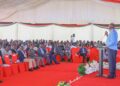
Speaking on Friday during the 2nd National Education Conference 2026 held at Lake Naivasha Resort, Basic Education Principal Secretary said the ministry intends to deploy 25,000 laptop computers and smartboards in public primary schools nationwide.
A smartboard is an interactive digital whiteboard that operates as a large touch-sensitive screen, enabling users to run computer applications, write notes and interact with digital content directly using fingers or digital pens.
These devices are widely used in classrooms and boardrooms and usually come with built-in systems that support internet browsing, screen sharing and document viewing.
Bitok explained that the programme forms part of the broader benefits expected from the rollout of the Kenya Education Management Information System (KEMIS), an upgraded digital platform set to replace the current National Education Management Information System (NEMIS).
The new system is designed to eliminate ghost learners and fraudulent funding claims by integrating data from all levels of education in real time, from Early Childhood Development (ECD) to universities and Technical and Vocational Education and Training (TVET) institutions, creating what the ministry describes as a more accurate and secure “single source of truth”.
“KEMIS is going to be a game changer because it has three principal components. First, we will be able to monitor data more effectively and more accurately,” the PS said during a panel discussion.
He noted that centralised learner data management across all education levels would improve transparency by allowing the government to track every learner throughout their academic journey.
“The second issue is the information system, which will give us feedback. Sitting in Jogoo House, I should be able to monitor through a security centre what is happening in schools across the country. I should be able to receive summarised information on issues such as student reporting in real time.”
Bitok said such access to real-time data would help the ministry make timely policy decisions based on information coming directly from schools across the country.
He added that the third advantage of KEMIS is its ability to support digital learning without putting excessive financial pressure on schools or the ministry.
“Through KEMIS, we are going to deploy some textbooks through the system. We will also be providing lessons from time to time, for example Mathematics Grade 9, where someone from a certain school can teach through the KEMIS network.”
Bitok said the government has already started rolling out the infrastructure required to support the ambitious programme.
“The Ministry of ICT is currently working on connectivity in schools, we are carrying out solarisation, and we are now deploying 25,000 laptops and smartboards in primary schools across the country,” he said.
As of 2025, Kenya had 39,339 primary schools, with 24,566 being public institutions.
“Those laptops should have software called KEMIS so that whenever they arrive in schools, they will be used to improve data management, monitor activities in schools and ensure the system is connected directly to headquarters in Nairobi,” Bitok added.
The smartboards are expected to transform classroom interaction between teachers and learners by moving away from the traditional chalk-and-talk approach towards a more interactive and learner-centred mode of teaching, which could also improve digital literacy.
However, questions remain over whether the government will fully implement the programme, considering the challenges that affected a similar initiative in the past.
The Sh32 billion Digital Literacy Programme introduced in 2013, which aimed to distribute tablets to over 21,000 schools, faced significant setbacks, including poor infrastructure, unreliable electricity supply and low utilisation in some schools.
The three-day conference, which ends on Saturday, brought together education stakeholders for discussions on reforms, leadership and accountability in the sector.
President , who officially opened the conference on Thursday, May 7, emphasised the government’s continued commitment to reforms under the Competency-Based Education (CBE) curriculum.