
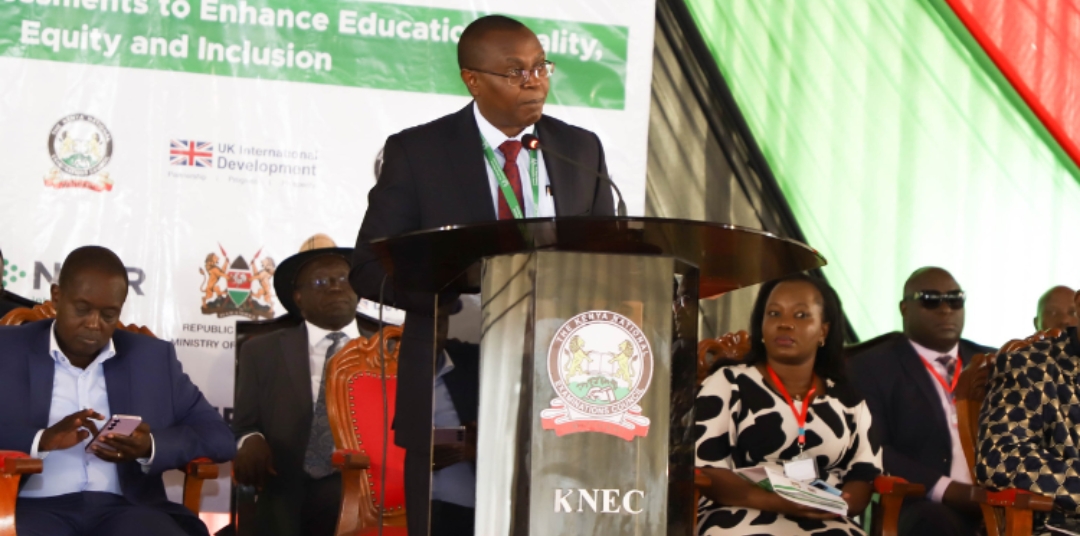
The Kenya National Examinations Council (KNEC) has announced a new opportunity for teachers and teacher educators (KNEC item writing training 2026) across the country to enhance their assessment skills through a specialised training programme.
This initiative is part of a broader effort to improve the quality of national examinations as Kenya continues transitioning to the Competency-Based Education (CBE) system.
Overview of the Training Programme
KNEC is set to conduct a one-week online training course starting on April 20, 2026. The programme is designed to equip selected participants with essential skills in developing high-quality assessment items that align with competency-based learning.
Upon successful completion, participants will be certified and may be considered for inclusion in KNEC’s pool of contracted professionals responsible for setting national examination questions.
- According to KNEC Chief Executive Officer David Njegere, those who complete the course will not only gain valuable skills but may also be engaged by the council whenever the need arises.
What is Item Writing in Competency-Based Assessment?
Item writing refers to the process of designing examination questions or tasks that accurately measure a learner’s knowledge, skills, and competencies. In the context of Competency-Based Education, item writing goes beyond simply testing memory.
Instead, it focuses on:
- Assessing understanding and application of knowledge
- Evaluating problem-solving and critical thinking skills
- Measuring real-life competencies and practical abilities
For example, rather than asking students to recall facts, a competency-based question may require them to apply concepts to solve a real-world problem, analyze a situation, or demonstrate a skill.
Key Features of Effective Item Writing
During the training, teachers will learn how to create assessment items that are:
- Clear and unambiguous – Questions should be easy to understand and free from confusion
- Relevant to curriculum objectives – Every item must align with the intended learning outcomes
- Balanced and structured – Exams should cover a range of competencies and difficulty levels
- Fair and unbiased – Questions should not disadvantage any group of learners
- Practical and skill-oriented – Focus on what learners can actually do, not just what they remember
These skills are critical in ensuring that assessments truly reflect a learner’s abilities.
READ ALSO: Best Free Teaching Apps for Kenyan Teachers In 2026
Why This Training is Important
The introduction of Competency-Based Education in Kenya has brought a major shift in how learning and assessment are approached. Unlike the traditional 8-4-4 system, which largely emphasized memorisation and high-stakes final exams, CBE focuses on continuous assessment and skill development.
Under CBE:
- Learners are evaluated over time
- Emphasis is placed on projects, portfolios, and practical activities
- Understanding and application are prioritized over cramming
As a result, there is a growing need for teachers who can design assessments that accurately measure competencies.
This training aims to bridge that gap by preparing educators to develop high-quality test items that reflect modern educational standards.
Transition from 8-4-4 to Competency-Based Education
Kenya is currently in the final stages of transitioning from the 8-4-4 system to Competency-Based Education. The last Kenya Certificate of Secondary Education (KCSE) examination under the 8-4-4 system is expected to be conducted in 2027, officially marking the end of the decades-old system.
This transition represents a significant shift in the education sector, with greater emphasis on:
- Skills development
- Creativity and innovation
- Real-world application of knowledge
To support this shift, assessment methods must also evolve—and that is where item writing becomes essential.
READ ALSO: How to Fill and Submit TSC TPAD Online (Step-by-Step Guide for Teachers)
Requirements for Applicants
KNEC has outlined strict criteria for teachers and educators who wish to apply for the training. Interested candidates must meet the following requirements:
- Be registered with the Teachers Service Commission (TSC)
- Have at least three years of teaching experience
- Be currently teaching in primary, junior, or senior school, or in teacher training institutions
- Possess relevant academic and professional qualifications
- Demonstrate expertise in their subject or learning area
- Be recommended by their head of institution
- Show familiarity with curriculum designs in their area of specialisation
- Exhibit high levels of integrity and professionalism
Note: It is important to note that teachers who have previously undergone similar training in item writing are not eligible to apply.
KNEC item writing training 2026
How to Apply and Deadline
Interested applicants are required to submit their applications online through the KNEC portal: markingapp.knec.ac.ke
The deadline for submission is April 13, 2026.
KNEC has emphasized that only shortlisted candidates will be contacted, so applicants are encouraged to ensure they meet all the requirements before applying.
READ ALSO: Transition from Junior to Senior School In Kenya: What we Know So Far
Benefits of the Training
Participating in this programme comes with several advantages for teachers, including:
1. Professional Development
Teachers gain advanced skills in assessment design, making them more effective educators.
2. Certification
Successful participants receive certification from KNEC, boosting their professional profile.
3. Opportunity to Work with KNEC
Participants may be contracted as exam setters, providing an additional source of income and professional exposure.
4. Contribution to National Education Standards
Teachers play a direct role in improving the quality and fairness of national assessments.
Conclusion
This initiative by KNEC is a timely and strategic move aimed at strengthening the quality of assessments in Kenya’s education system. As the country fully embraces Competency-Based Education, the role of teachers in designing effective assessment tools cannot be overstated.
By training educators in item writing, KNEC is not only enhancing classroom assessment practices but also building a strong pool of professionals capable of delivering high-quality national examinations.
Teachers who meet the requirements are encouraged to take advantage of this opportunity to grow professionally and contribute to shaping the future of education in Kenya.
KNEC item writing training 2026