
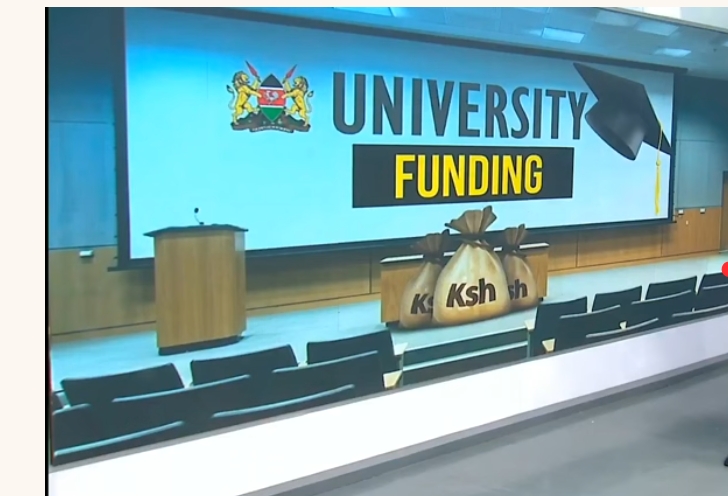
The Ministry of Education has defended the proposed Tertiary Education Placement and Funding Bill, saying it will help the government achieve its target of 100 per cent transition to institutions of higher learning.
While appearing before the National Assembly Education Committee, three Principal Secretaries from the Ministry of Education explained how the proposed fund will draw from a combination of government grants, borrowing through the capital markets, parents’ savings, student loan repayments and concessional loans.
The funding is expected to help meet the growing financial demands in the higher education sector, which are projected to reach Ksh.230 billion.
Higher Education Student Numbers Expected to Double
The Ministry of Education projects that the number of students enrolled in higher education will double from the current 1.2 million to 2.4 million by the 2030/2031 financial year.
To meet this growing demand, the government has proposed a new higher education funding model that ring-fences an annual Ksh.100 billion government grant.
The Ksh.100 billion will bring together existing allocations of Ksh.56 billion to the Higher Education Loans Board (HELB), Ksh.30 billion to the Universities Fund and Ksh.9.6 billion for TVET scholarships.
However, with the higher education sector already facing significant funding gaps, members of the National Assembly Education Committee questioned where the additional resources needed to sustain the growing demand would come from.
HELB Explains Proposed Bond Financing
HELB CEO Geoffrey Monari explained that the government plans to use a bond programme to raise additional funds from the commercial sector.
“We will use the bond programme to go to the commercial sector and we will be paying coupons every quarter. The first requirement and simulation we did was that we will require an additional Ksh.80 million, which then we’ll be paying coupons every six months of Ksh.5 billion, which makes it affordable from the government,” Monari said.
He explained that the proposed financing would provide an alternative source of funding beyond the Ksh.100 billion government allocation.
Loans to Cover Students in Public and Private Universities
Higher Education Principal Secretary Beatrice Inyangala said the proposed funding model would allow eligible Kenyan students to access loans regardless of whether they enrol in public or private universities.
“The boom is back. The loans will be awarded to students, irrespective of whether they go to a public or private university because it is equal treatment of all students who are Kenyans,” Inyangala said.
The proposed Bill seeks to provide 100 per cent loan financing to students who qualify to join institutions of higher learning, a proposal that raised questions from members of the committee over the sustainability of the programme.
MPs Question Sustainability of the Funding Model
Igembe North MP Titus Taitumu questioned whether the government would have the financial capacity to sustain the proposed funding model.
He noted that the government has struggled to meet its existing capitation obligations in secondary schools.
“The government is not even capable of raising money for capitation because we know in secondary schools the government is supposed to be funding Ksh.22,000 per learner, but that amount the government is not able to raise. Currently, you’re providing about Ksh.16,000…”
Monari, however, said the proposed bond programme could be supported through concessional financing in the future.
“After three years, we are now able to go to concessional loans at less interest and we have calculated between 1–3 per cent. There is a grace period of 10 years because you can repay for 30 years, then you can be able to retire the bond programme and continue paying for students for a period of even up to 50 years as we continue going back to the bond market,” he noted.
Proposed Parent Savings Scheme
The proposed Tertiary Education Placement and Funding Bill also introduces a voluntary parent savings scheme.
Under the proposal, parents will be able to save towards their children’s higher education from birth or at any stage before the child enrols in a tertiary institution.
Monari said the scheme would be regulated by the Capital Markets Authority (CMA) and would provide returns on parents’ savings.
“The scheme will be regulated by CMA and will have a separate and transparent way of running the returns because there will be returns because it is your savings. It will be put back to the account of that parent so that when the child reaches higher education, then we can be able to pay directly to the institution,” Monari said.
Shift From Need-Based to Universal Student Funding
The proposed Bill seeks to shift Kenya’s higher education financing system from a need-based model to universal student funding.
Under the proposed system, all eligible students would be able to access financial support based on the cost of their course and their upkeep requirements.
The government says the proposed framework is intended to expand access to higher education, address the rising cost of financing students and help achieve the target of 100 per cent transition to higher learning institutions.
However, lawmakers continue to raise concerns about the long-term sustainability of the proposed funding model, particularly as student numbers and the cost of higher education continue to increase.